

Nobody Owns the Mic, and Your Company Is Paying For It

Everyone talks. Nobody communicates. And your competition is winning because of it.
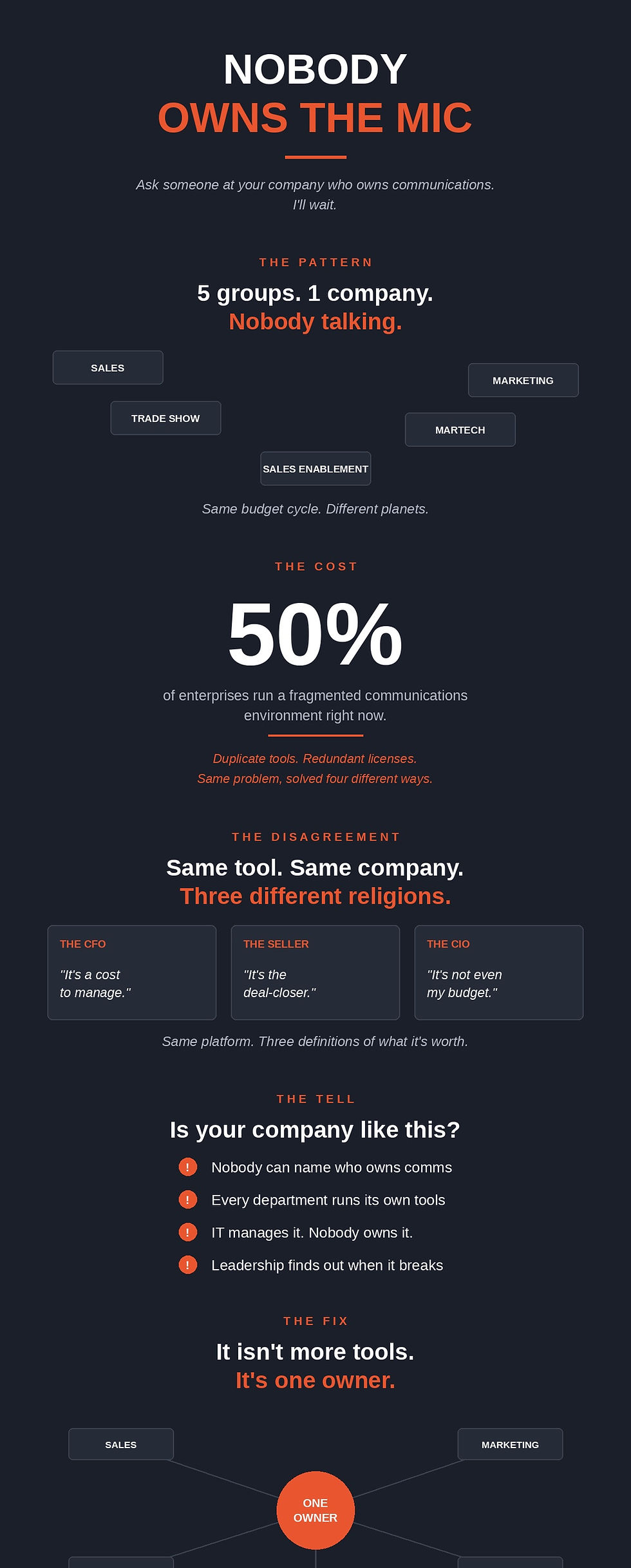
Ask someone in your company who owns communications.
I'll wait.
If you got a clean answer you're either very lucky or nobody told you the truth yet.
I've been in this industry over 25 years. Sold UC to companies large and small. Then sat inside those same types of organizations running UC strategy from the CIO office. Watched it from the street and from the boardroom. And I can tell you, the view is equally frustrating from both sides.
The pattern never changes.
Sales has their tools. Marketing has theirs. The trade show team, the demo monkeys, show up to conventions with a completely different setup that nobody back at HQ knows exists. Martech is doing their thing. Sales enablement is somewhere in the middle trying to hold it all together with duct tape and optimism.
Five groups. One company. Nobody talking to each other.
I've sat in rooms where one team had a full production operation and the team down the hall was running the equivalent of two tin cans and a string. Same company. Same budget cycle. Different planets.
Here's what makes this worse. This isn't one bad company or one bad CIO. Research shows half of all enterprises are operating a fragmented UC environment right now. Half. And they're all paying what the industry quietly calls a fragmentation tax. Duplicate tools, redundant licenses, multiple vendor contracts solving the same problem four different ways.
When something breaks, and it always breaks, everyone looks around waiting for someone else to own it.
UC and corporate communications aren't treated as strategy. They're treated as a utility. Like the electricity bill. You only notice it when the lights go out.
We spend millions on the technology and almost nothing on the thinking behind it. The tools are there. The strategy isn't. And that gap, between the tech and the intent, is where companies quietly lose ground every single day.
So who owns it at your company?
The proof was never in the boardroom. It was on the train.
When I was leading sales and running weekly industry trainings, I used to tell my teams something that got me some very interesting looks.
"Everyone in this company is a seller."
Engineers. Accountants. Operations. Everyone.
You should have seen the faces.
One engineer straight up asked me what I was smoking.
I didn't argue. I just asked a question back.
"How many of you ride BART? Take a train? Sit on a plane?"
Hands went up.
"You're not selling 24 hours a day. But at some point someone sitting next to you asks what you do. What do you say? Do you say I'm an engineer and let it die? Or do you tell them something that actually means something?"
That's when it started clicking.
These weren't sales people. Never would be. But they learned how to talk about what they did in a way that was human, real, and actually interesting. An elevator pitch that didn't sound like an elevator pitch.
It stuck. I still run into some of those engineers at different companies today. They're still doing it.
Here's why that matters for UC.
At Ustream we had self-serve plans. Churches used us to stream Sunday services. Regular people. Personal accounts. Nothing enterprise about it.
Then someone would show up to work Monday morning and mention it in a meeting. "Hey my church uses this for their stream, it works really well." Someone perks up. A conversation starts.
Next thing you know we're getting inbound calls from enterprises. Not because of a campaign. Not because a seller knocked on the door. Because a human had a conversation.
NASA streamed with us. Monterey Bay Aquarium too. You think those conversations started in a boardroom? They started because someone saw something that worked, remembered it, and brought it back to work.
No marketing budget. No demand gen campaign. No strategy meeting.
Just humans communicating.
Now here's the business case nobody is putting on the strategy slide.
Internal UC fragmentation doesn't just create confusion, it drains money. Duplicate tools sitting on three different budgets. Teams solving the same problem four different ways. Nobody knows what the group down the hall bought last quarter.
But flip it around. When your internal house is unified, same tools, same message, same strategy, you become your own best case study.
The most powerful sales conversation isn't a pitch. It's proof. "We use this internally. Here's what it saved us. Here's what changed." That's not selling, that's evidence. And evidence closes deals that pitches never could.
Your people are already out there representing your company every day. On trains. At church. At their kids' soccer games.
The question is, what are they saying? And does anyone in your organization actually care enough to make sure they can say it well?
The CFO, the CRO, and the CIO walk into a meeting
Same company. Same tool. Three completely different religions.
Ask your CFO what UC is worth.
Then walk down the hall and ask your top seller the same question.
I'll bet you get two completely different answers.
The CFO sees a line item. A cost to manage, minimize, and justify at budget time. UC sits somewhere between the electric bill and the coffee subscription in terms of strategic priority.
Your seller? They'll tell you UC is the difference between a deal that closes and one that ghosts. Between a relationship that builds and one that stalls. Between a prospect who feels heard and one who feels processed.
Same tool. Same company. Two completely different religions.
Now go ask your CIO.
There's a structural problem most organizations won't say out loud. In many companies the CIO isn't operating as a true C-level peer. They're managing infrastructure, babysitting vendors, and trying to keep the lights on with a budget that gets raided every time another department has a higher priority. Communications sits even below that. Without its own budget line, without its own seat, without its own voice at the revenue table.
So when something needs a decision it gets deprioritized. Every time. Until it breaks. And by then there's no budget left to fix it right because everyone already spent it on their own team's priorities.
This isn't anyone's fault individually. It's an organizational design problem masquerading as a technology problem.
And it's industry wide.
I've seen it at startups and Fortune 500s. I've sold into it and I've sat inside it. The companies that treat the CIO as a true strategic peer, and treat communications as a revenue pillar rather than a support function, consistently outperform the ones that don't.
Here's what I've learned watching this play out for 25 years.
Companies don't have a technology problem. They have a priority problem.
Mordor Intelligence puts the UC and collaboration market at roughly $236 billion today, with one forecast reaching $779 billion by 2031. Companies are spending the money. They're just not spending it with a strategy behind it. And the average desk worker is now juggling seven different communication channels daily. Not because they need seven, but because nobody made a decision about which one wins.
That's not a tech stack problem. That's a leadership problem.
This isn't just an IT conversation. It's not just a sales conversation. It's not just a finance conversation. That's exactly the problem. Everyone thinks it belongs to someone else. The CFO thinks it's IT's problem. The CIO thinks it's a budget problem. The sellers know it's a revenue problem but nobody upstairs is listening.
And the customer sits in the middle wondering why your company can't tell a consistent story.
Who in your organization is having this conversation right now?
Why your CIO probably isn't really a CIO
This one might sting. Good.
I've said this in boardrooms. I've said it to CEOs. I'll say it here.
In most companies the CIO title exists. The actual authority rarely comes with it.
That's not an attack. That's an observation from someone who has lived on both sides of it, as a seller walking into CIO offices for 25 years and as someone who has sat inside one.
Most CIOs are doing one of three things at any given moment. Managing infrastructure. Putting out fires. Or sitting in a budget meeting defending spend that every other department is trying to reallocate toward their own priorities.
Communications sits even below that.
Think about that for a second. In most organizations the function responsible for how every employee, every seller, every executive, and every customer experiences your company is treated like facilities management. Essential until it works. Invisible until it breaks. And never given a real seat at the revenue table until a deal falls apart or a crisis hits.
Mail gets its own budget. Facilities gets its own budget. Security gets its own budget.
Communications? It gets pulled from whoever has room this quarter.
And then we wonder why nobody owns the mic.
Here's the truth the industry doesn't want to say publicly because it implicates too many org charts. The companies winning right now, truly winning and not just surviving, have a CIO who sits at the table as a genuine strategic peer to the CFO and CRO. And they have communications treated as a revenue function, not a support function. It has its own budget. Its own strategy. Its own seat.
Not borrowed from marketing. Not borrowed from IT. Its own.
When that structure exists something remarkable happens. The message is consistent from the trade show floor to the boardroom to the engineer on BART. The tools are unified. The strategy is clear. And the company stops paying the fragmentation tax.
I've helped organizations consolidate five communication platforms into one. Cut costs by tens of millions. Unify the message across 300,000 employees. And create the kind of internal clarity that actually shows up externally, in how sellers talk, how support responds, how leaders communicate.
That's not a technology story. That's a leadership story.
So here's the question I want to leave every CIO, CFO, CRO, and CEO with.
If your five most important customers asked five random employees what your company stands for and how you communicate, would they get one story or five?
Because your competition already knows the answer.
The ones pulling ahead aren't winning on features or price. They're winning because everyone in their organization, from the executive suite to the engineer riding BART, is telling the same story, with the same tools, pointed at the same goal.
That's not a UC implementation. That's a culture. And culture doesn't happen by accident.
It happens when someone decides to own the mic.
For 25 years I've helped people and companies communicate using AI, cloud, and video. These are the conversations I've been having the whole time, and I'm always open to having them.
A shorter version of this piece ran as a four part series on LinkedIn.

Comments